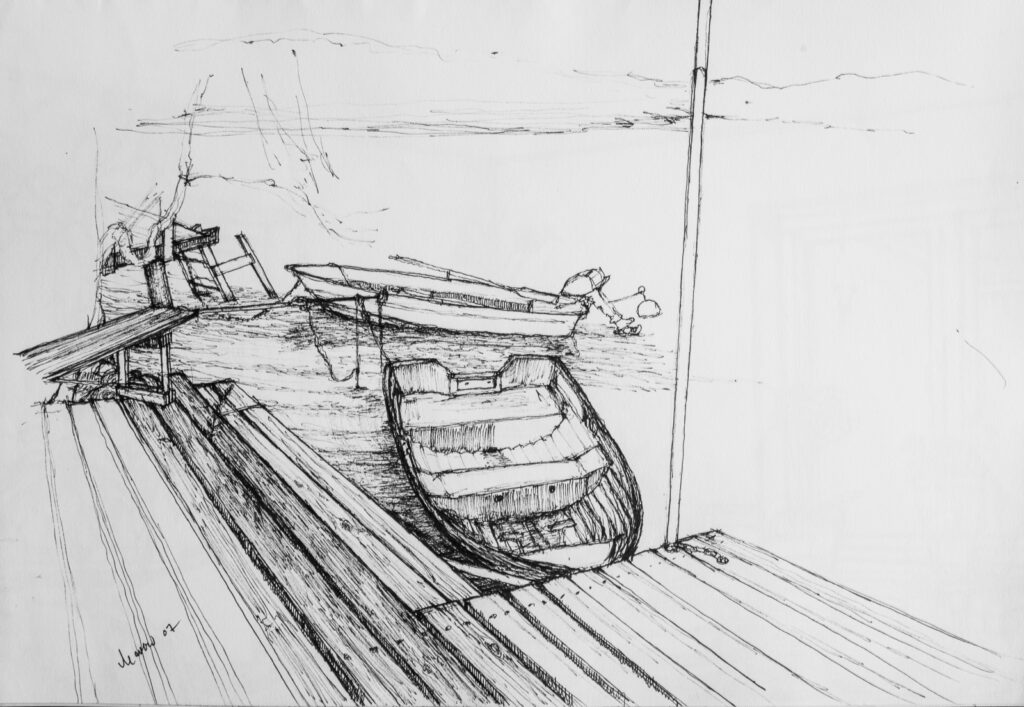
John Adam Barrow is a Cape Town-born fine artist of South African and Swedish descent. Working exclusively with oil on canvas, John paints from his home studio in De Waterkant, a neighbourhood nestled within the city bowl of Cape Town. As of 2026, John will be splitting his time between Stockholm and Cape Town.
Born on March 22, 1963, John grew up in Cape Town, studying art through to Matric. He completed his undergraduate degree in architecture at the University of Cape Town and his Masters at the KTH Royal Institute of Technology in Stockholm.
John began his career as a freelance architect in Stockholm, where his debut project—an Italian Espresso Bar in the city centre—earned him early acclaim.
He later became a partner in a Stockholm-based architectural firm. From his youth to early middle age, his years in Europe were spent studying, travelling, starting a family, and working.
Immersed in the splendour of Western art and architecture, he painted as a hobbyist throughout this time, finding deep inspiration in the Old Masters.
Despite early success in a foreign land and a prosperous career in architecture, John made the decision to return to his birthplace, Cape Town, in 2006 to pursue his lifelong passion as an artist.

The familiar yet new local context sparked his love for vivid colour, inspired by the bold hues and patterns found in local African dress and the flags of nations across the continent.
While his works are almost exclusively representational, a small number of abstract pieces can be found in his series A Pattern Language.
This collection of abstract studies in line, pattern, and colour reveals John’s intentional use of geometry and his penchant for structured, stable compositions. These paintings also echo the work of renowned South African artist Esther Mahlangu.

Line drawing by the artist, illustrating his method of dividing the canvas into geometrical forms—squares, the golden ratio, and other symmetrical shapes.
Upon his return, South Africa was still in the early stages of its new democratic dispensation. This socio-political context grounded John’s image-making in a strong sense of place and ignited his passion for creating art as a form of social commentary.
While previous works like Marikana (2015) and Silent Scream (2020) focused on local issues, his preoccupations have since broadened to global themes: geopolitics and war, life in the Anthropocene, world history and religion, ecology and neoliberalism.
A recent painting, Weird Realism (2024), part of his Space Time series, illustrates some aspects of the “weirdness” that is baked into the reality of our lives. Can one produce a realist-style painting without acknowledging the often invisible—but very real and increasingly threatening—objects that impinge on external reality and our individual consciousness?
Key visual elements in Weird Realism reference Artificial Intelligence and the dominance of Big Tech in shaping information flows and humanity’s common future.
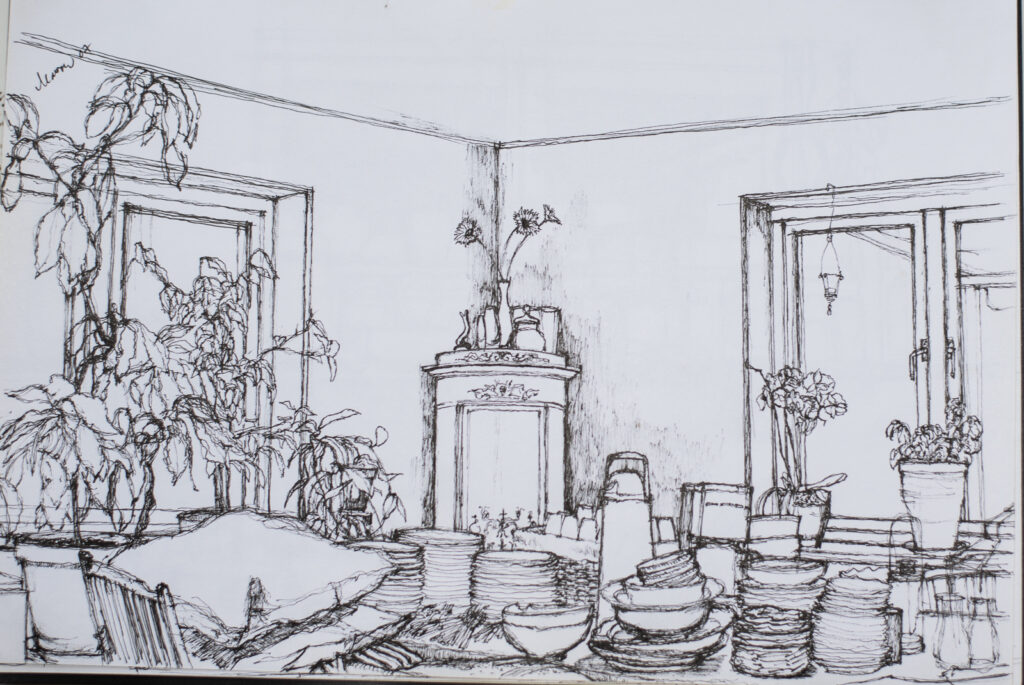
Connecting humanity’s violent history and myths with the present and future, the Space-Time series explores planetary and personal themes related to the Metacrisis.
This is vividly embodied in The Kitchen (2024), an interior portrait scene charged with foreboding energy, channeling everything from the power of ideas, humanity’s primitive history to contemporary Middle Eastern conflicts, and the ultimate threat to all life: nuclear war.
To date, John has showcased his work in only a handful of settings. He recently participated in The City of Cape Town’s Emerging Artist Program, a government-run group show gathering early-career visual artists across various ages and artistic mediums.
Last year, he also presented his paintings for non-commercial purposes via WITS University and later in collaboration with a collective of civil society organisations. For John, engaging with broader societal issues through his art is as crucial as building a commercial career.
Although his work impresses on the viewer a strong display of colour, form, and originality, audiences may find great reward in using his paintings as a springboard into significant conversations about humanity and the planet.
These dialogues arise naturally, as the paintings are an extension of John’s personal value system. John’s journey as a full-time artist began later in life.
His quiet diligence and years of relative solitude were instrumental in helping him “catch up” while developing his technique and visual language. Operating independently of the art market and prioritising his craft away from the public eye has meant that, until now, the artist has not yet had the opportunity to participate in a major solo or group exhibition.
Now, with an oeuvre of over one hundred original oil paintings, this period marks an important shift for the artist as John endeavours to showcase, for the first time, his paintings with a large audience.